How to Play Catan with 7 or 8 Players
By the Tavernly team ·
You invited eight people, and the Catan box is already on the table. To play Catan with 7 or 8 players, I'd first split the group into two smaller games or pair people up on shared colors. A bigger island works as a house variant, but extra tiles do nothing about the wait between turns.
Can you play Catan with 7 or 8 players?
The short answer
There is no current official 7-8 player extension for standard Catan. You can run two smaller tables, pair players on shared colors, or build a larger board and use an adapted paired turn rule. The last two are house variants.
The wait decides how well Catan for a big group works. With eight people each playing alone, you watch seven turns before yours comes back. Pick a setup that shortens that wait before you buy anything.
Which option fits your group?
The time column only compares the setups.
| Option | What you need | Time | Best for | The catch |
|---|---|---|---|---|
| Two tables of 3-4 | Two complete base games and playing surfaces | Ordinary small games, running together | Mixed experience | Tables finish at different times |
| Teams of two on one board | One base game | Four decision turns per circuit; partner talks add time | Eight guests happy to share | Each person has less control |
| One big board, every player alone | Extra terrain, cards, pieces and written house rules | Expect a long session | Experienced enthusiasts | Setup and negotiations grow |
| A different game for the night | A party game whose stated count includes everyone | Choose a duration your guests accept | Casual company | Save Catan for a smaller gathering |
If you're planning a first board game night, settle the guest list and find out how keen everyone is on Catan before you make a shopping list.
How do you play Catan in teams?
In this house version, partners share one color, one hand of resources, their development cards and a score. A pair counts as one player for production, discards and building, so the color gets the same resources as any other color.
Seat partners side by side so they can look at their hand together without showing it. Sitting across works if everyone keeps their cards hidden, but it makes talking harder. With seven guests, an experienced player who wants to can take a color alone, without a partner's advice.
Take turns leading: the lead partner rolls, proposes the build and handles offers while the other advises, and you swap each turn. A beginner who only holds the cards while their partner decides everything isn't really playing. Before you start, teach the game to new players so both partners can help.
Talk over possible trades quietly inside the pair, then make the real offer and the exchange out loud. A quiet word with your partner should never turn into a secret deal with an opponent.
Keep the normal ten-point target the first time. A higher target, such as eleven points, is a house choice that can make the game longer, and sharing a seat is no reason on its own to raise it. With four colors you keep the usual four-player turn order, as long as partners decide quickly.
How do you run two Catan tables at once?
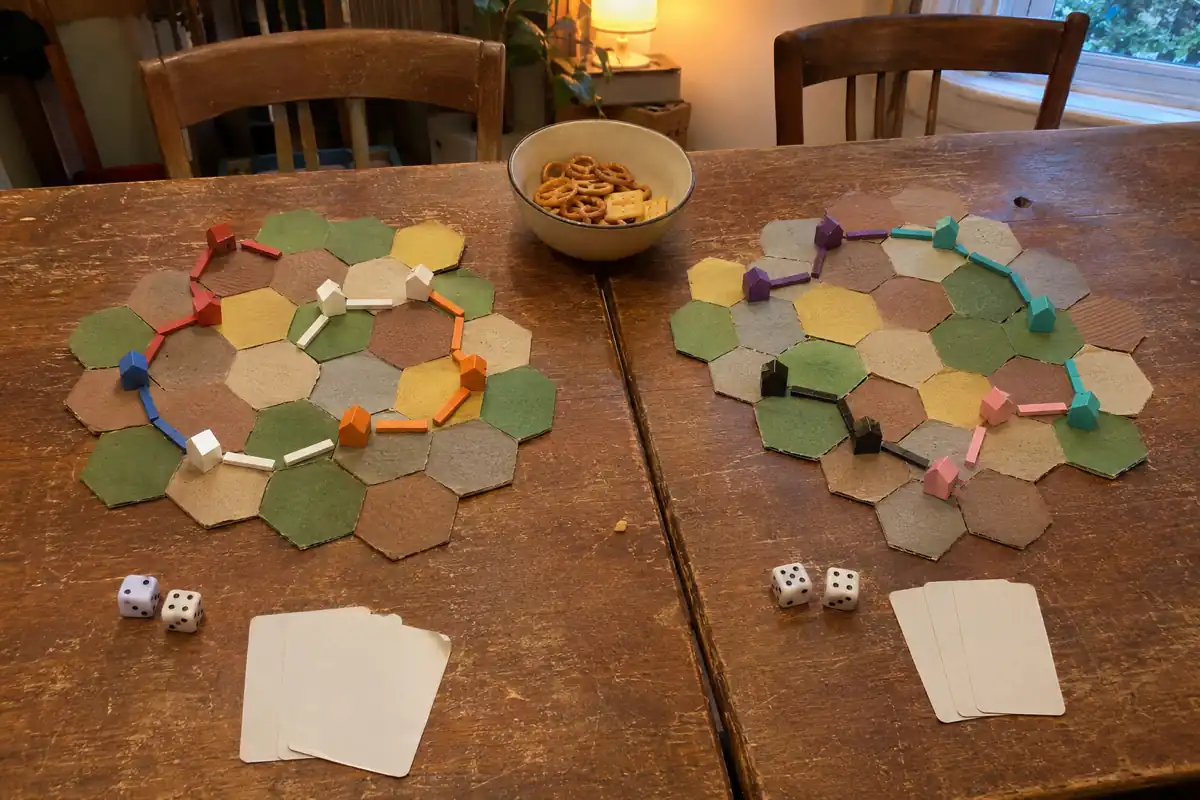
If you worry that splitting eight guests leaves someone out, set up both games before anyone starts, so everyone has a seat from the first roll. Ask a guest to bring a second complete base game; an extension alone can't make the second table.
Offer one table for experienced players and one for learners, with a willing teacher at the learning table. Let friends pick their own table instead of seating people by skill. Put the tables close enough to chat, but don't make the host referee both games all night.
Plan what comes next before the first roll: something short for whoever finishes early, then mixed players for a second game, or a final if everyone wants a contest. Don't promise a final if guests only have time for one game.
I'd keep the two games separate. Trading between tables is one more house rule: it joins their economies as well as the people, and players wait for a trader at the other table, which costs the speed you split the group for.
How do you build a Catan board for 7-8 players?
Build and check the island before guests arrive. The Catan 5-6 player extension adds terrain, frame pieces, cards and player pieces for a fifth and sixth player, with no layout or rules for more.
A base game plus two base-game extensions can give you the material for a custom island. Count the pieces before you buy, because a second copy of the same box repeats its colors. The current English extension adds green and purple, and the earlier English version had green and brown, so mixing the two still gives you two greens. Repaint or mark the duplicate sets so nobody mixes them up.
Keep the normal supply for each color: five settlements, four cities and fifteen roads. Check card sizes and backs when you mix editions, because development cards with different backs give away information; matching opaque sleeves fix that.
Lay out more land than the normal extension island, then check that the last players to place still have useful starting spots under the settlement distance rule. Extra land along one narrow coast does little for them. Make sure everyone can reach the middle without knocking pieces over.
For example, try a wide oval with forests and fields at both ends, hills on opposite coasts and mountains inland. Keep your normal island's mix of resources and spread the good number tokens across the resource types; too much extra pasture makes wool plentiful and everything else scarce. Nobody has tested this layout for balance, so check it before anyone picks a starting spot.
Modern frames are hard to improvise with, because the harbors are printed on the frame pieces. Lay out the outline first, and where it doesn't close, agree how you'll mark the coast and the harbor intersections. Spread harbors around the island with a fair mix of generic and resource harbors, and check your edition's contents before you count on loose harbor markers.
What rules keep 8 player Catan moving?
Start with the official Paired Players rule for five or six players, and tell the table which parts of your version are house rules. Paired players still play against each other and keep their own hands.
- Give Player 1 the dice. In the official rules, Player 2 is the third player to Player 1's left.
- Player 1 rolls, resolves production or a seven, then trades and builds as normal. They can also play a development card under the usual limits.
- When Player 1 is done, Player 2 can build, buy development cards, trade with the supply and play a development card. Player 2 doesn't roll and can't trade with other players.
- Pass both markers and the dice one seat to the left, and roll for the next production.
For eight seats, my house change puts Player 2 four seats to the left, straight across from Player 1, so everyone acts every fourth roll. With seven seats, the gaps are three and four rolls in turn. The publisher has no rule for this, and two action phases per roll still take time.
Under the current rules, a development card you buy as Player 2 can be played when you are next Player 1, and the other way round. That extra chance can make cards more useful.
A common tip is to add the Special Building Phase. Today the extension rules replace it with the paired system. You can still choose the older system on purpose: after each normal turn, the other players build or buy development cards in clockwise order. During that phase they can't trade, not even with the supply, and can't play development cards. Use one system or the other, never both.
Your choice changes the robber. More production rolls between your chances to spend fill your hand and expose it to more sevens, though extra players don't change the odds of any single roll. The older build phase lets you spend after every turn, so you discard less. Paired turns interrupt the game less, but your hand sits longer between chances to act.
Write down the discard limit before setup. Normally, a player with more than seven resource cards when a seven is rolled discards half, rounded down; I'd keep that for the first game. A higher house limit makes saving easier and weakens the robber further, and it does nothing for slow decisions.
Agree on a turn timer if everyone wants one, paused for rules questions, and plan purchases while others play. Keep trade offers loud enough for the whole table during Player 1's phase. I'd skip letting any two players trade at any time: it removes Player 2's trade limit and starts several negotiations at once. On your first large board, use only the base game's rules.
Is a large Catan game fun?
Choose the big island if everyone already knows the game, likes to negotiate and wants a long, social evening. If a six-player game already feels slow to you, more seats are unlikely to help.
A weak start can leave a player at the table with little production and few real choices while their chance to catch up shrinks. Agree beforehand how much of the evening the game can take and what you'll do if time runs out.
My rule: if any guest is new or not keen on the experiment, split the table or give them a partner. If the group mostly wants to talk, choose a party game for that many guests and play Catan with four another night.
FAQ
Is there an official 7-8 player expansion?
The standard extension line stops at six players. CATAN Connect (formerly Big Game) is a separate official event format for large gatherings, with a long board made for the event and players acting at the same time, so it is no model for your normal island.
How long does a 7 or 8 player game take?
Plan for much longer than a four-player game if everyone plays their own color, since placement, trading and buying all take longer. The publisher gives no playing time for this setup, so don't promise a finish based on a smaller game's box.
Can you combine two 5-6 extensions?
Yes, if the editions work together, but another extension alone won't give you eight different player colors or balanced rules. Check what you own against your planned board before you order.
Can you play Catan online with more than 6 players?
Not on CATAN Universe, which allows up to six players in the modes that support it, or on Board Game Arena, which lists three to four. Set up two online games for your group; see how to play Catan online before you choose a service.
This guide is not affiliated with or endorsed by the owner of Catan. Catan is a trademark of its owner.