How to Play Kanban EV Online
By the Tavernly team ·
Kanban EV is a board game by Vital Lacerda, published by Eagle-Gryphon Games and Skellig Games. You can play it on Tabletopia, or try our free browser game with no account: we make Cogsmere on Tavernly.
The short answer (checked 2 October 2026)
- The original: Tabletopia offers a free one-week trial. We could not confirm what a free account may do after it ends.
- Free, with friends, no account: Cogsmere on Tavernly has private tables with invite links.
- Learn as you play: Cogsmere on Tavernly has a guided lesson. We played all 43 steps.
Which way is right for you?
We checked these choices on 2 October 2026. Tabletopia lists the original and offers a free trial, but we could not confirm access after it ends. Cogsmere on Tavernly offers bots, private tables and a guided lesson for free, with no account.
| You want to… | Best choice |
|---|---|
| Play the original online | Tabletopia, with an account |
| Try the original's solo version | Tabletopia lists an official solo version |
| Play free with friends and no account | Cogsmere on Tavernly, at a private table |
| Play against bots | Cogsmere on Tavernly, with Easy, Medium or Hard bots |
| Learn during a game | Cogsmere on Tavernly, with Learn by playing |
Kanban EV on Tabletopia
You can play Kanban EV on Tabletopia with an account. Its play page offers a free one-week trial that includes Premium games. Tabletopia also has a free app on Steam for Windows and Mac, and a free App Store app. We did not test Kanban EV in the apps.
- Open the Tabletopia play page and press Sign up to play Kanban EV. If you already have an account, use Log In.
- Choose Start FREE Trial to try Premium games during the free one-week trial.
- Pick a table.
- Invite your friends to the table.
The logged-out page has both a “Free” tag and a Premium access message. We could not confirm what a free account may do in Kanban EV after the trial. Check this while logged in before arranging a game with friends.
You can also get Tabletopia through Steam or the App Store. These are Tabletopia apps. The Steam page says guests do not need accounts, but we did not test a guest table for Kanban EV.
A Kanban EV alternative: Cogsmere on Tavernly
Cogsmere on Tavernly is our free browser board game for 1 to 4 players, with no account needed. It has its own theme, art, names and rules text. You can play against bots, invite friends or learn with a coach. Our version has no expansions and does not include the original's optional variants.

Tavernly asks for your birth month and year once. The game is for players aged 13 and over.
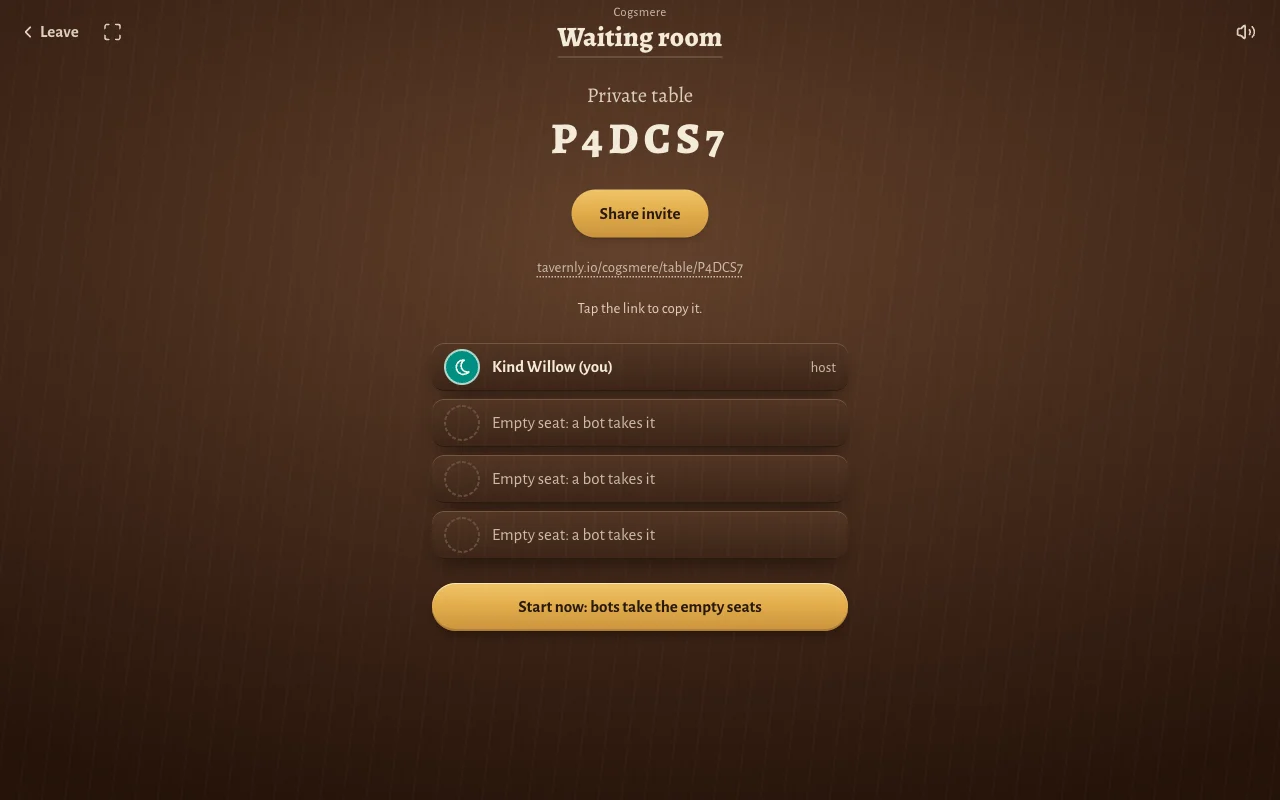
- Play against bots: open Cogsmere on Tavernly, choose 1, 2 or 3 opponents, and pick Easy, Medium or Hard bots. Press Play now. Bots take the empty seats within five seconds.
- Play with friends: press Play with friends, choose 1, 2, 3 or 4 seats, then press Open a private table. Use Share invite to send the link. Friends join in the browser with no account. When they are in, press Start now: bots take the empty seats.
- Learn by playing: press Learn by playing to start a real game with a coach beside you.
What "Learn by playing" teaches
We played all 43 steps of the lesson in Cogsmere on Tavernly on 2 October 2026, against one bot. We used a desktop-width window only. We did not test a phone.
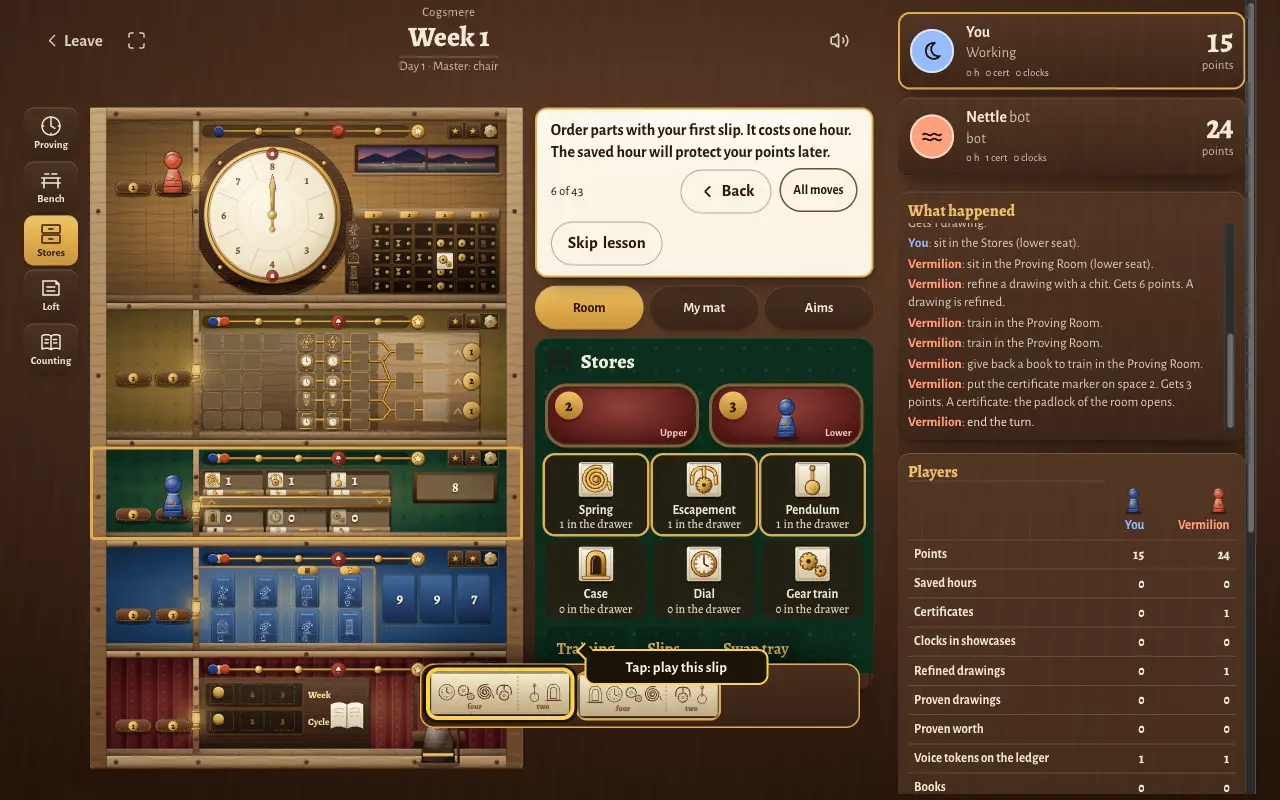
The coach rings the part of the table you need. A small label tells you what to tap, such as “Tap: sit here” or “Tap: play this slip”. Use Back and Next to move through the lesson, or Skip lesson to leave.
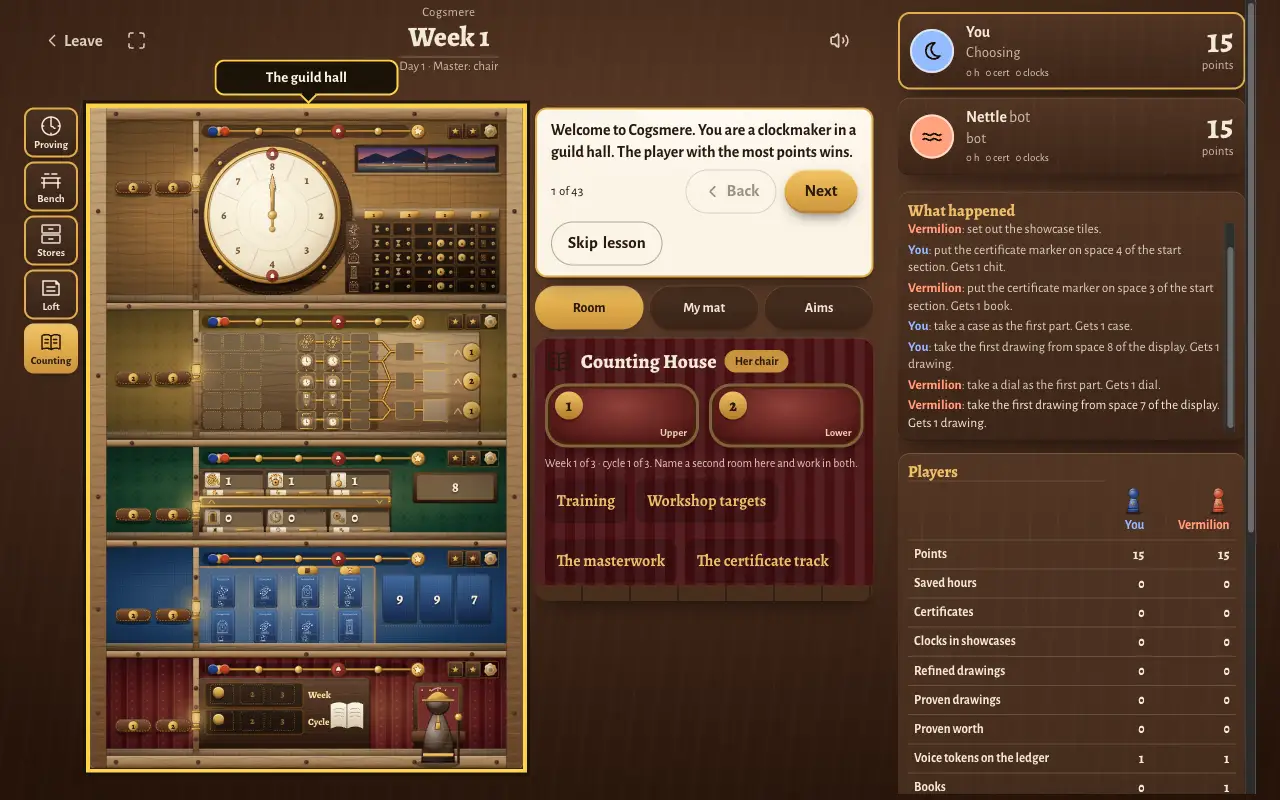
The welcome step puts you in a guild hall as a clockmaker. You are aiming for the most points. The lesson then introduces the five rooms: each day you choose a room and a seat, then work there.
At step 6, you use an order slip to bring parts into the Stores. This costs one hour and gives you a saved hour. That saved hour matters later, when the Guildmaster checks your work.
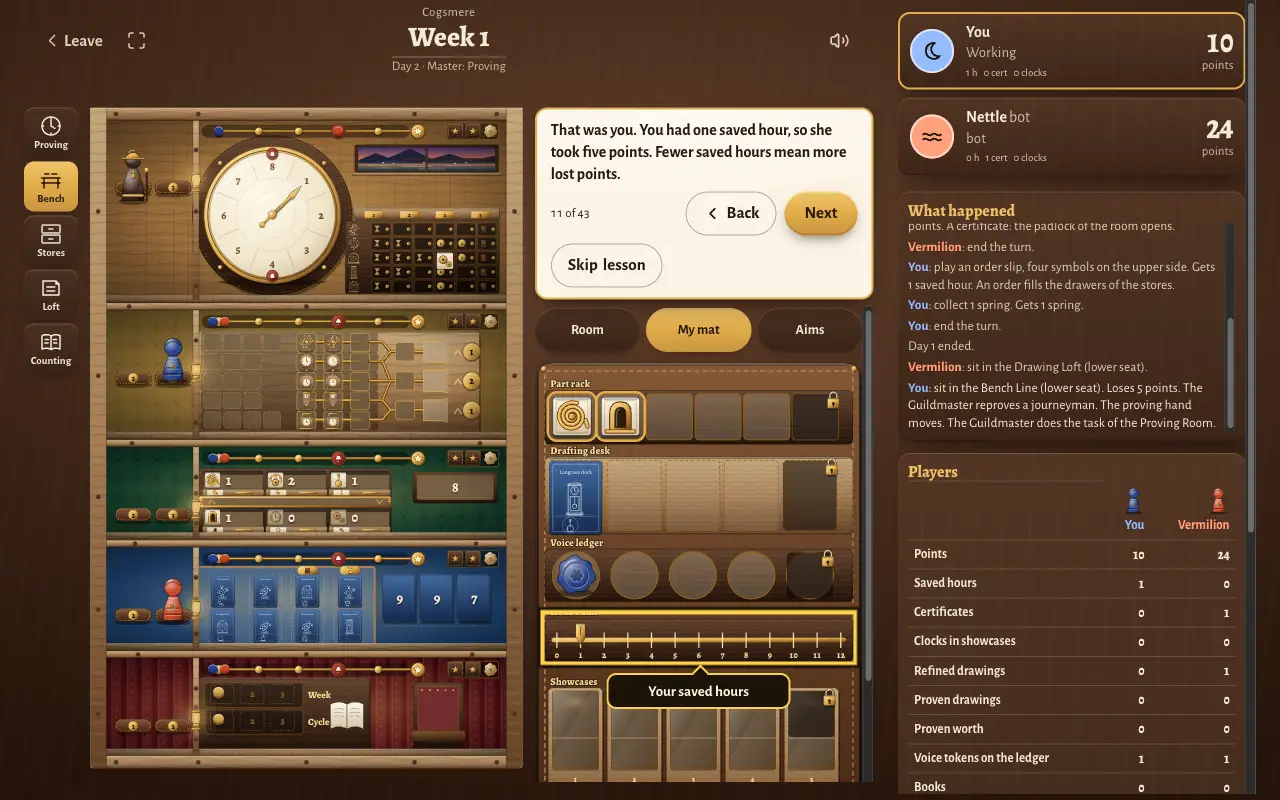
Step 11 made that check clear. We were lowest on the Proving Room's training track and had one saved hour. The Guildmaster took five points from us. Fewer saved hours mean a larger penalty.
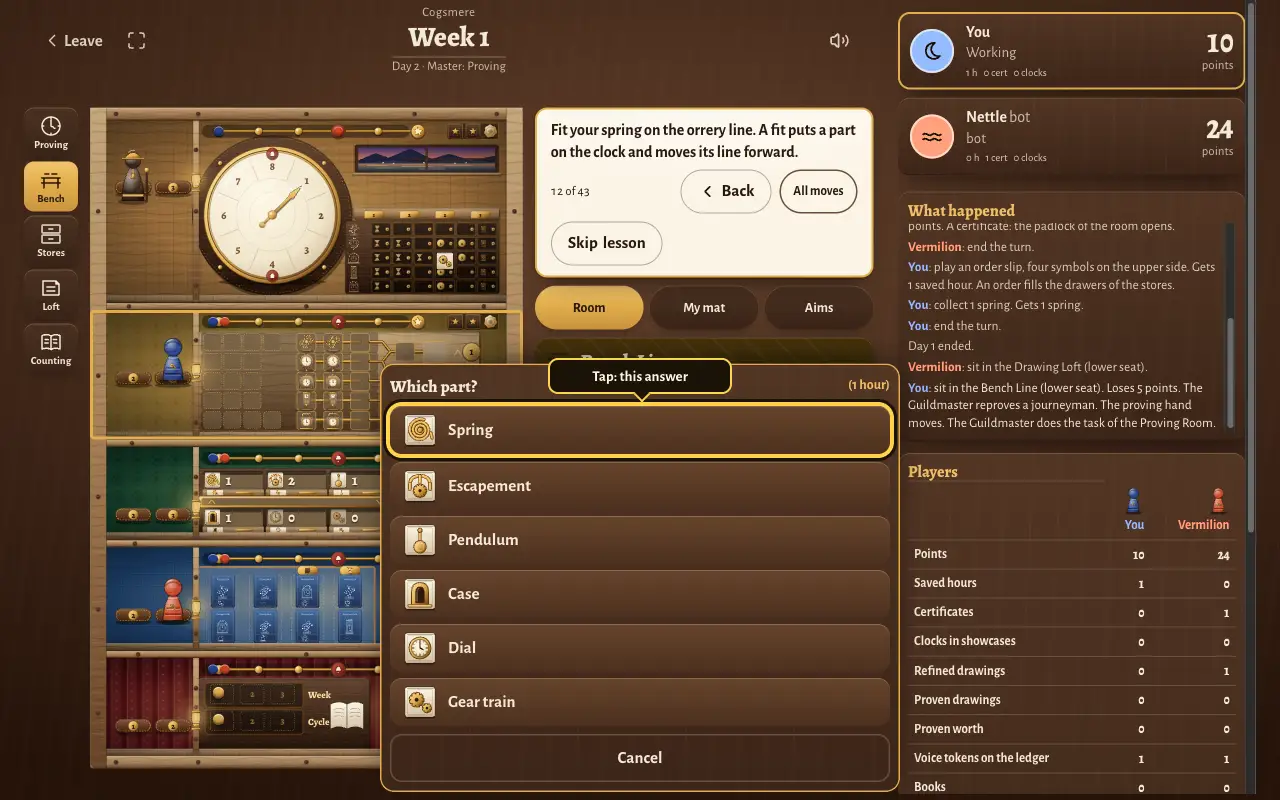
At step 12, you fit the spring you collected onto the orrery line. A box asks which part to use. You choose the spring.
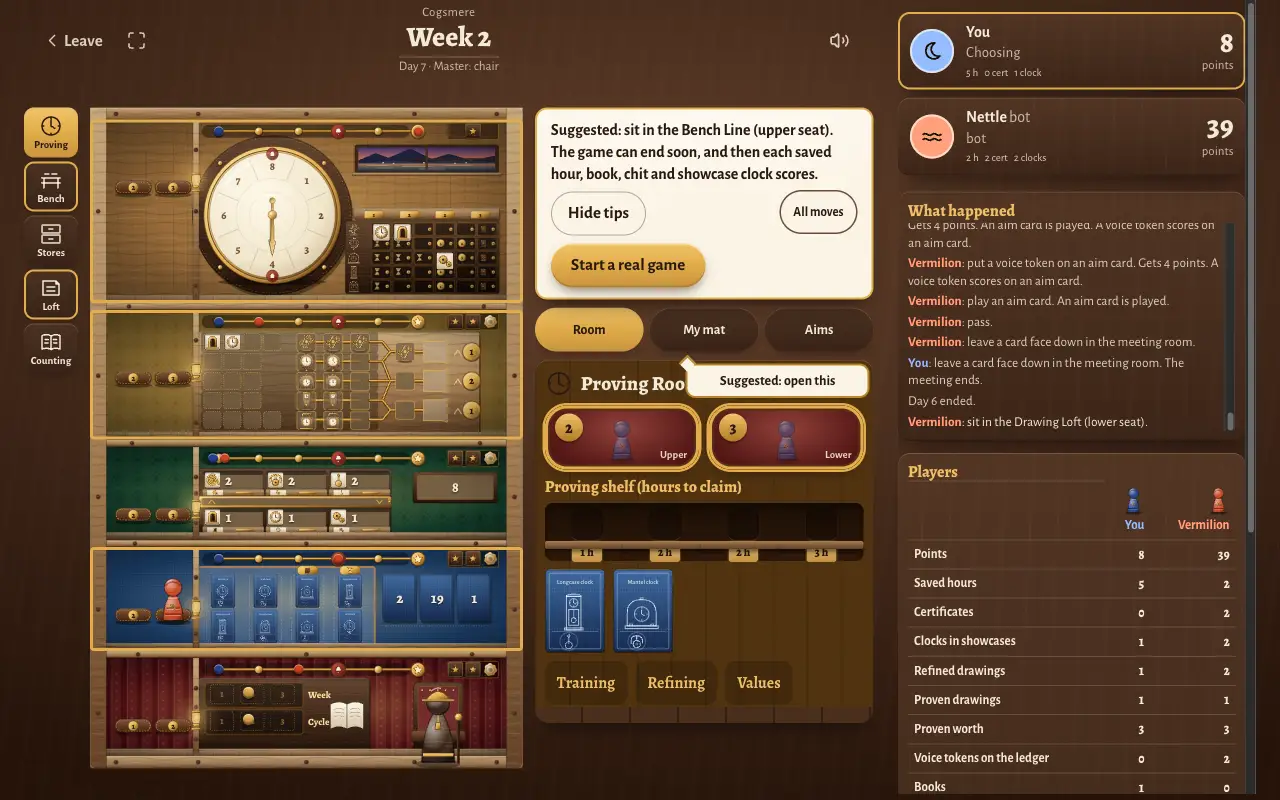
Step 43 asks you to keep playing to the end. The lesson table goes on as a real game. The coach suggests a move each turn, but you may choose any move. You can use Hide tips or open All moves.
These plain words help you read the names used in Cogsmere on Tavernly:
| Plain words | Names in Cogsmere on Tavernly |
|---|---|
| worker | journeyman |
| manager | Guildmaster |
| department | room (Proving Room, Bench Line, Stores, Drawing Loft, Counting House) |
| shift | hour |
| shifts you keep | saved hours |
| car part | part (spring, escapement, pendulum, case, dial, gear train) |
| car | clock (mantel, wall, longcase, carriage, orrery) |
| design | drawing |
| upgrade a design | refine a drawing |
| assembly line | bench line |
| test track | proving dial |
| garage | showcase |
| speech token | voice token |
| goal cards | aim cards |
The rules in two minutes
This recap covers Cogsmere on Tavernly, our version. You work in a guild hall, collect parts, make clocks and score points. Each day you choose a room, then spend hours there. A game in Cogsmere on Tavernly takes about 75 minutes.
Setup. Each player starts with 15 points, 1 chit, 3 aim cards and 2 order slips, and takes 1 part and 1 drawing. A chit can stand for any part you choose.
A day. Choose a free seat, then work. From day 2, you must change rooms. With 1 or 2 players, you cannot enter the Guildmaster's room. In the first four rooms, the upper seat gives 2 hours and the lower seat 3. The Counting House gives 1 and 2. Most tasks cost 1 hour. You can add saved hours, but use no more than 4 hours in a day. Unused hours are lost; saved hours stay in your bank, which holds 0 to 12.
The rooms. Each room gives you different work:
| Room | What you do |
|---|---|
| Stores | Order parts with a slip, gaining 1 saved hour; collect parts from one drawer; or swap a part with the swap tray for free. |
| Drawing Loft | Take drawings. The two right columns give a book or a saved hour. |
| Bench Line | Fit a part to move clocks along that model's line. Parts on a model must be different kinds. The three exits pay 1, 2 and 1 points, then send the clock to the proving shelf. |
| Proving Room | Return a matching drawing to claim a clock. Shelf places cost 1, 2, 2 or 3 hours. Put it in a showcase for its bonus once. Or refine a drawing with its part for 2 points, raising that part's end value up to 6. |
| Counting House | Name another room and work in both. This is the only way to use a room on two days in a row. |
A refined drawing is proven when you have a clock of its model in a showcase.
Training. Spend 1 hour to move up the training track of the room where you work. Step 3 gives a certificate and opens a lock on your mat. Step 5 gives an honour. At the end, each track pays 5, 3 and 1 points to the first, second and third player.
The Guildmaster. From day 2, she moves one room down each day and checks the players lowest on that room's training track. If a checked player has 2 or fewer of what the room asks for, they lose 1 point, plus 1 for each saved hour below 5. She then does the room's task.
In the Counting House, she holds the weekly reckoning. Each clock in a showcase scores 1 point for each part on its model's refining spaces, plus 1 for each of your proven drawings of that model.
The meeting. A guild meeting begins when the proving hand reaches a bell mark. Each player must play exactly 1 aim card. Put a voice token on a free x3, x2 or x1 space of a card. It scores for each time you meet the aim, up to that multiplier. The meeting ends when all players pass one after the other.
The end. The game ends after the day when one of the week and cycle markers is on step 2 or more and the other is on step 3. Finish that day. Both tracks have 3 steps.
Score these in order:
| What scores | End points |
|---|---|
| Masterwork feats | The feats you meet |
| Saved hours | 1 each |
| Voice tokens on your ledger, books and chits | 1 each |
| Clocks in showcases | Mantel 2, wall 3, longcase 4, carriage 5, orrery 6 |
| Training tracks | 5, 3 and 1 for first, second and third |
| Proven drawings | The current value of each drawing's part kind |
Most points wins. A tie goes to the most clocks, then the most proven drawings, then the most saved hours.
The box of the original may differ in numbers, and the rulebook in the box decides there.
Tips for playing online
For your first game, keep saved hours near 5 and look one room down from the Guildmaster before you choose where to work. Train a little in every room you visit. Avoid wasting hours, and check the free swap tray before you fit a part.
- Keep saved hours near 5. A checked player who has too little of what the room asks for loses 1 point, plus 1 for each saved hour below 5.
- Look one room down from the Guildmaster.
- Train where you work. The Guildmaster checks the players lowest on the room's track, so train a little in each room you visit.
- Unused hours are lost. You cannot use more than 4 in a day.
- Before fitting a part, check the swap tray: swapping a part there is free.
Questions people ask
Tabletopia lists the original board game, and Cogsmere on Tavernly offers our own game for free with no account.
Can I play Kanban EV online for free?
Tabletopia offers a free one-week trial that includes Premium games. We could not confirm what a free account may do in Kanban EV after that trial, so check the play page while logged in. Cogsmere on Tavernly is our free browser game with no account needed. It has its own theme, art and names.
Do I need to download anything?
You can use Tabletopia in a browser, and Cogsmere on Tavernly also runs in a browser with no download. Tabletopia has a free Steam app for Windows and Mac and a free App Store app. Those are Tabletopia apps. We did not find a separate Kanban EV app on the App Store.
Can I play Kanban EV alone?
The Tabletopia page says Kanban EV has an official solo version. In Cogsmere on Tavernly, you can choose bots as opponents or open a private table with one seat for the solo rules. That solo game runs two colleagues, Ash and Wren. They are part of the rules, and their points are taken from you.
Can I play Kanban EV with friends online?
On Tabletopia, sign up, pick a Kanban EV table and invite friends. Check access while logged in before you arrange the game. In Cogsmere on Tavernly, press Play with friends, open a private table and use Share invite. Friends join through the browser link with no account. Start when they are in; bots fill empty seats.
Can I play Kanban EV on my phone?
Tabletopia has apps, including an App Store app, but we did not test Kanban EV in them. Cogsmere on Tavernly runs in a browser, and we played its lesson at desktop width only. We did not test a phone. We cannot confirm phone play for either choice from the checks behind this post.
How many people can play?
Tabletopia lists Kanban EV for 1 to 4 players. Cogsmere on Tavernly also supports 1 to 4 players. Its private table lets you choose 1, 2, 3 or 4 seats. One seat uses the solo rules; at a table with friends, bots take seats that are still empty when you start.
How long does a game take?
Tabletopia lists Kanban EV at 1.5 to 2.5 hours. Cogsmere on Tavernly lists about 75 minutes. Our version gives you 45 seconds to choose a room and 90 seconds for a work turn. If a timer runs out, the table makes a safe move for you and spends nothing.
Sources
We checked these pages on 2 October 2026: Tabletopia for the original's listing and trial, Steam and the App Store for Tabletopia's apps, and Cogsmere on Tavernly for our version. We also played our full lesson that day. We did not test Kanban EV in the apps or our game on a phone.
- Tabletopia, Kanban EV: the designer, the publishers, players, play time and the solo version.
- Tabletopia, Kanban EV play page: the sign-up, the free trial.
- Steam, Tabletopia: price, platforms and guests.
- App Store, Tabletopia: the mobile app.
- Cogsmere on Tavernly: the rules, seats, timers and bot levels of our own game.
Cogsmere is not affiliated with or endorsed by the owner of Kanban EV. Kanban EV is a trademark of its owner. As an Amazon Associate we earn from qualifying purchases. If you want the physical game, here is Kanban EV on Amazon.